
TADAAKI TONEGAWA
AUDIOPHILE
"POST MERIDIEM"
In the heart of Kyoto, Tadaaki Tonegawa’s PM Sounds is less a record bar than a living tribute to analog sound and the joy of discovery. Born from passion rather than profit, it’s a place where generations gather and time slows. After years of perfecting his sound at home, Tonegawa opened PM Sounds to share that warmth, trading the quiet fade of retirement for the chance to create something lasting. With vintage equipment carefully curated and an atmosphere that feels both intimate and open, the bar has become a haven for music lovers, artists, and audiophiles. Here, the goal is not simply to hear, but to truly listen.

Prologue
Analog Culture in Japan thrives in vinyl bars, listening cafés, and private music libraries—spaces where sound becomes ceremony and music is treated as ritual. Curators and audiophiles preserve rare pressings and foster spaces for deep listening, anchored by vintage sound systems. More than nostalgia, these gatherings offer continuity and presence—a slower rhythm in a fast world, where music is not just heard, but felt. Vinyl here represents continuity: a devotion to craft, patience, and presence in a society that values subtlety. In an era of streaming and speed, Japan’s record bars offer something rarer—a slower rhythm, a shared silence, and a reminder that music is not only heard, but felt.
In a narrow street in Kyoto, tucked behind weathered shutters and a modest sign, there’s a room where the past hums with precision.
When the Needle Drops, Life Expands: Turning the question, “What comes next?” into an analog sanctuary where sound—and purpose—deepens.
PM Sounds began not with a business plan, but with a moment. A feeling. The kind of warmth only analog playback can deliver—when the needle drops and a familiar melody blooms with a richness digital formats can’t quite touch. But it also began with a question Tonegawa couldn’t shake: what does retirement look like, if it doesn’t shrink you? “In Japan, so many people grow quiet after they retire,” he reflects. “They get small. They ask how much pension they’ll get, and then they just… fade.” But during six years spent in the United States, Tonegawa saw another path: people savoring life after work. Starting new things. Staying curious. “It was inspiring,” he says. “I didn’t want to disappear. I wanted to build something. I’ve been an audio fan for over 50 years. One day, I finally got the sound just right—at home. And I thought… maybe someone else should hear this too.”
So he built PM Sounds—a bar, a listening room, and an intergenerational gathering space. The equipment is meticulously chosen: high-end vintage components arranged into what he calls three “design systems.” But there’s no tech snobbery here. What matters isn’t specs—it’s experience. “I just wanted to share good sound with people. That’s all.” And in doing so, Tonegawa did something more: he created a community. Designers, musicians, sound engineers in their 30s and 40s stop in. They bring ideas, swap records, contribute to the atmosphere. “Yesterday a young designer dropped by,” he recalls. “We talked for hours. That’s the joy of it.” At PM Sounds, it’s not unusual to see a mix of regulars: an old friend from the neighborhood, a 22-year-old crate digger, a foreign audiophile with a map in hand. What unites them is the music, of course—but also the space itself. It’s warm, wood-lined, and sincere.
“One day, I finally got the sound just right; and I thought maybe someone else should hear this too.”
What surprises most first-time visitors is how unhurried the space feels. PM Sounds isn’t a place you “go out” to—it’s a place you settle into. The lighting is soft, the seating intentional, and the soundtrack is never background noise. Tonegawa curates each session the way a chef shapes a tasting menu: mindful of tempo, texture, and emotional arc. Some nights lean soulful and slow, others spark with jazz improvisations or unexpected deep cuts. But there’s always a thread—a sense of care guiding every transition. “Music should breathe,” he says. “If it moves you even a little, then the room has done its job.”
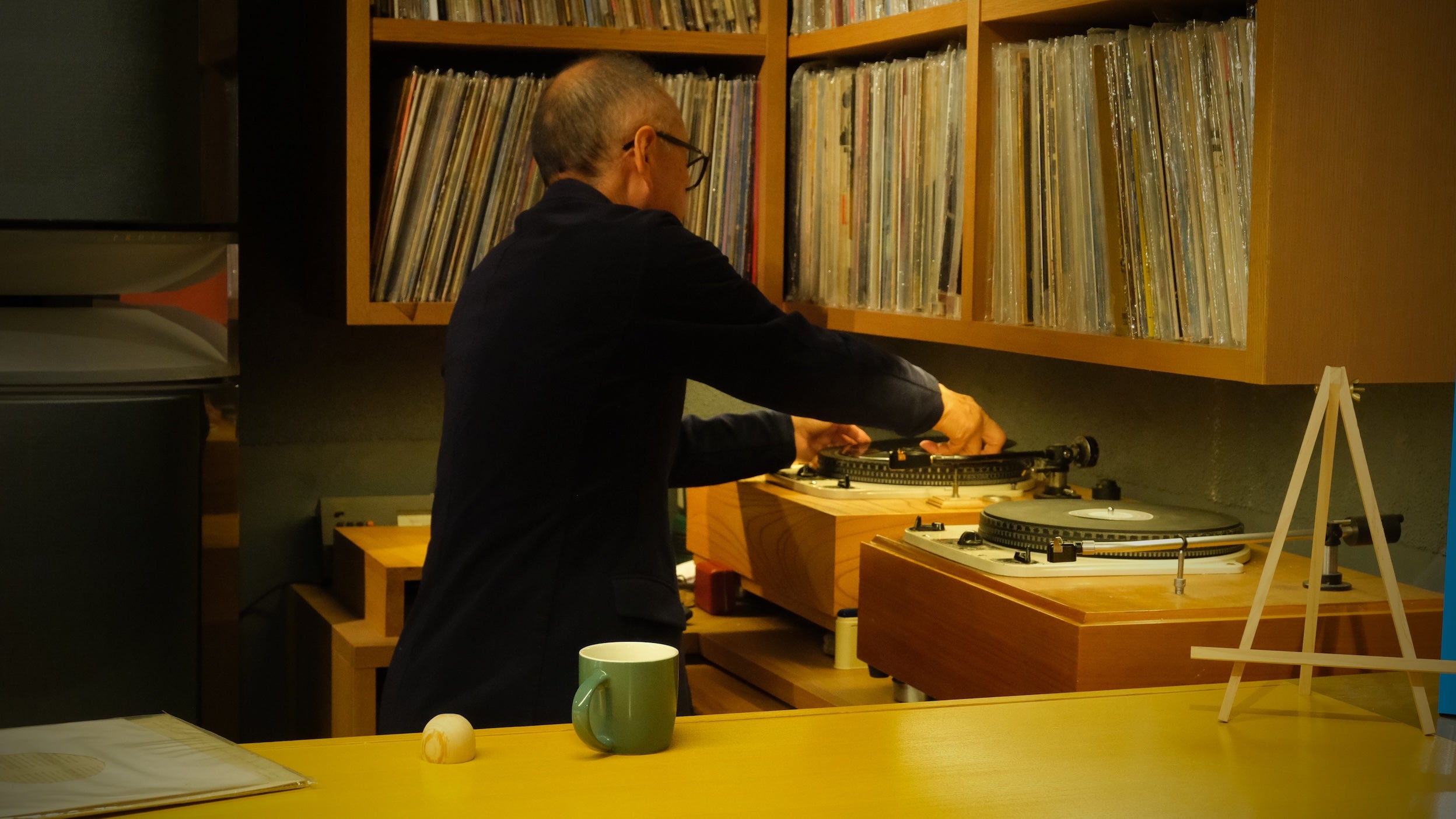
The Art of Listening: Transforming curiosity and care into a sanctuary where music bridges generations.
Over time, the space evolved beyond listening. PM Sounds slowly became a kind of urban sanctuary—an antidote to isolation. Younger visitors find mentorship in Tonegawa’s decades of audio and life experience; older visitors find renewed curiosity through the energy of the next generation. Occasionally, someone brings in a record inherited from a parent or discovered in a dusty store abroad. They play it, and suddenly strangers share a moment that feels deeply personal. “There’s a lot of emotion in people’s collections,” Tonegawa notes. “I love watching the room respond.”
And Tonegawa isn’t finished building. He’s already thinking about workshops, guest-curated nights, maybe even small exhibitions that connect analog culture with contemporary design. But expansion isn’t the point—continuity is. PM Sounds is less a business than an ongoing act of care, a testament to what can emerge when someone refuses to fade and instead chooses to participate, to offer something crafted, intimate, and real. “I think we all want to be part of something,” he says. “Music just makes it easier to connect.” In that way, PM Sounds offers not just sound, but a way of living—one defined by curiosity, presence, and the simple pleasure of hearing a record played well.
“There’s a lot of emotion in people’s collections, I love watching the room respond.”
Even with new ideas on the horizon, Tonegawa remains focused on the quiet moments that define PM Sounds. A casual conversation over a shared record, the way sunlight hits the wood-paneled walls in the afternoon, or the subtle nod of recognition between regulars—these are the threads that weave the space together. “It’s not about expansion or fame,” he says. “It’s about sustaining something real, something that reminds us why we fell in love with music in the first place.” In these details, PM Sounds proves that a space built with care can do more than play music—it can cultivate patience, curiosity, and connection across generations.


Analog Reverie: Where Sound Becomes Presence
There are no distractions. No apps. No algorithms. Just sound—chosen by hand, played with care, and received with the reverence of shared libations. Asked what keeps him going, Tonegawa laughs. “It’s two things,” he says. “I wanted to share the joy of great sound. And I wanted to enjoy myself, even as I got older.” Simple, perhaps. Yet in a world that moves faster than ever, PM Sounds offers something radical: a place to slow down and truly listen. Not just to music—but to the richness of what a good life can still sound like. Within its walls, time stretches, and each record played becomes a shared moment of presence. What lingers is not just sound, but connection—between people, memory, and the enduring warmth of analog.
“It’s two things, I wanted to share the joy of great sound; and I wanted to enjoy myself, even as I got older.”
Visitors often arrive alone, but leave having shared something intimate without even realizing it. Conversations flow naturally, sparked by a rare pressing, a memory a song evokes, or the simple joy of discovery. Strangers become collaborators in the moment, exchanging not just music, but stories, laughter, and perspective. In this quiet sharing, PM Sounds becomes more than a listening room—it becomes a bridge across generations and experience.
The space itself seems to breathe. Wood panels hum with resonance, vintage equipment glows softly, and each track carries a rhythm all its own. Tonegawa moves between stations, adjusting a needle, swapping a record, or pausing to comment on a favorite passage of sound. His presence is subtle but grounding, a reminder that attention—to music, and to one another—is the true medium of this room.


“It’s about sustaining something real, something that reminds us why we fell in love with music in the first place.”
Records are sometimes new discoveries, sometimes treasures from decades past. Yet no matter the era, each is treated with the same care, the same respect. Listeners lean in, close their eyes, or nod in recognition. In these gestures, the room hums with quiet appreciation—a collective acknowledgment of what it means to really hear, and to be heard in return.
PM Sounds quietly challenges assumptions about aging, curiosity, and creativity. Older visitors rediscover playfulness; younger visitors gain insight into the depth behind a single needle drop. Life does not diminish with age, nor does enthusiasm fade. Here, every listener is reminded that exploration—whether of music, design, or human connection—remains endlessly possible.
And yet, despite its careful curation and intentional design, the room never feels rigid. Moments of spontaneity—a requested track, a visitor’s unexpected record, a conversation that drifts late into the night—keep the space alive. In this delicate balance of discipline and improvisation, PM Sounds becomes not just a haven for analog sound, but a living experiment in presence, attention, and the joy of being fully engaged.
EXPLORE


