
TOMOHIRO NAITO
ARCHITECT
"FORM & MEMORY"
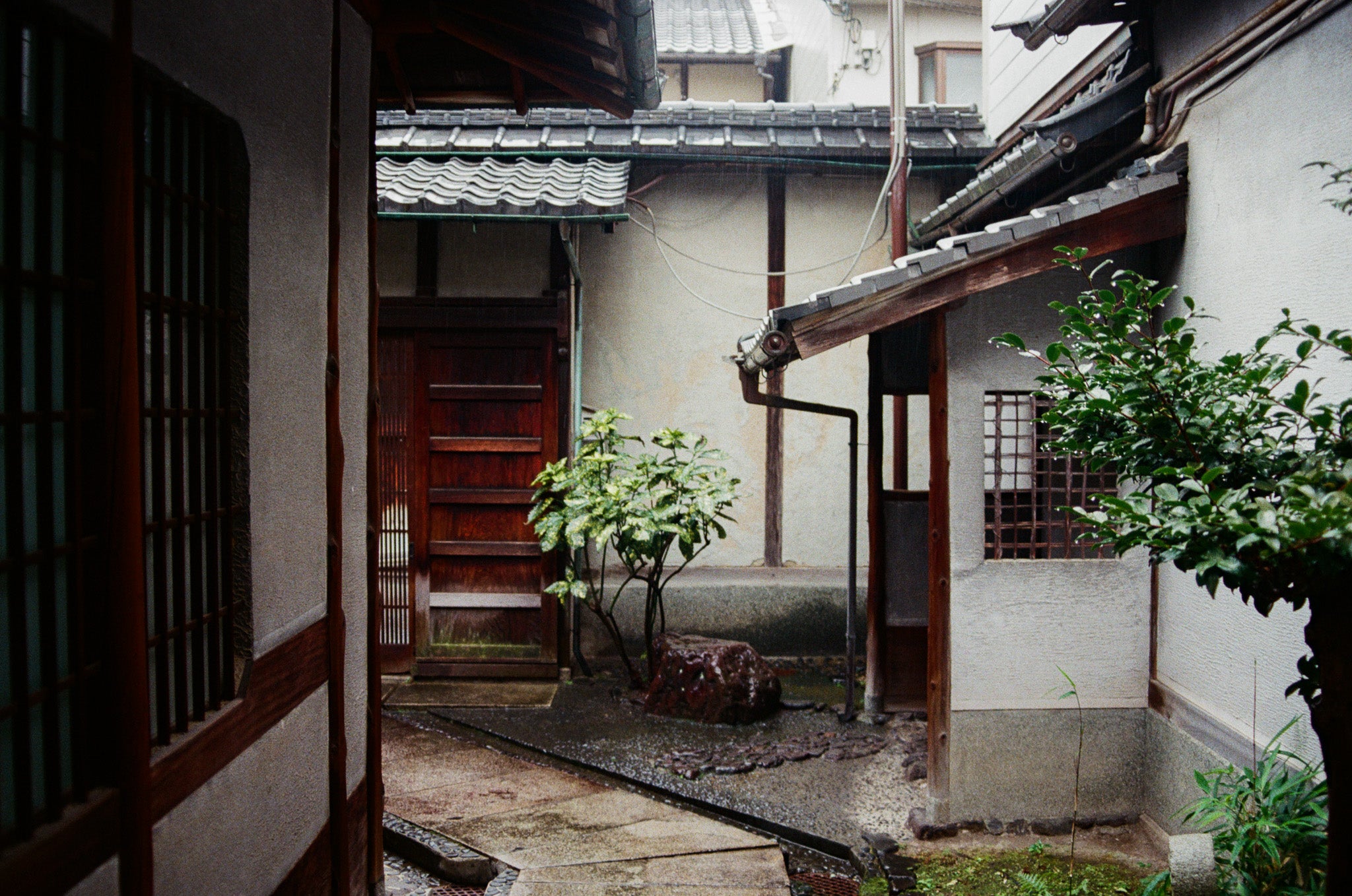
Kyoto was soaked in a steady winter’s rain, the kind that deepens the grain of old wood and hushes the city’s usual chatter. From a narrow machiya where JapanCraft21 had hosted our interview—its rooms dim and fragrant with age—Tomohiro Naito stepped out into the weather and invited us to follow. We wound through alleys glossed with water, past latticed facades weathered by generations, until we reached something once thought impossible: a new machiya, mid-construction, rising into the future.

Prologue
Machiya represents traditional wooden townhouses of Japan, which flourished during the Edo period (1603–1868) as centers of urban life, commerce, and craftsmanship. Characterized by narrow facades, deep interiors, and latticework exteriors, they were designed to accommodate both living and business under one roof. Constructed with timber frames, clay walls, and tiled roofs, machiya exemplify the harmony of function and aesthetic, balancing ventilation, natural light, and modular spaces. Beyond their architectural form, machiya embody a cultural rhythm—an intersection of domestic life, artisanal practice, and community engagement—preserving the intimate scale and enduring spirit of historic Japanese cities.
Not a renovation, not a museum, nor a replica, rather... it's a new beginning.
Where History Meets Innovation: The Modern Revival of Kyoto’s Machiya While Adapting to the 21st Century
For over sixty years, Kyoto had banned the construction of new machiya—the city’s iconic wooden townhouses—due to concerns about structural safety and thermal inefficiency. In summer, the interiors trapped heat; in winter, they offered little insulation. Their elevated timber frames, resting on individual foundation stones, left them particularly vulnerable in earthquakes. As building regulations advanced, machiya were gradually deemed obsolete—architecturally revered, but functionally abandoned.
So Naito studied building projects around the world for techniques to improve machiya construction. In each site, he found hints on how to harmonize tradition with innovation. Hidden reinforcements. Breathable insulation. Subfloor heating. Passive ventilation. All rendered invisible—out of respect for the form. Each idea he adopted carried the DNA of machiya, reimagined for a world where comfort and code could no longer be ignored. Together with Steve Beimel—a Los Angeles–bred Japanophile with a reverence for tradition so deep it verges on spiritual—Naito compiled years of research and field data resulting in a compelling case. That the machiya could live again—safely, sustainably, and beautifully.
Their proposal went beyond technical fixes; it was a manifesto for cultural preservation. Every structural enhancement was carefully considered to maintain the machiya’s visual poetry—the latticed facades, the narrow courtyards, the interplay of light and shadow—while meeting contemporary standards. Materials were sourced with an eye toward sustainability, drawing from local timber and natural finishes that echoed historical practices. Even modern systems, from climate control to plumbing, were integrated discreetly, ensuring the house’s character remained intact. In doing so, Naito and Beimel demonstrated that reverence for history need not preclude progress, and that the legacy of Kyoto’s streetscapes could thrive in a 21st-century cityscape.
The Quiet Revival of Kyoto: How Tradition, Intuition, and Innovation Breathe Life into the City’s First New Machiya in Ninety Years
Eventually, they took their work to Kyoto’s municipal government. This wasn’t a protest, but a proposal. A quiet campaign for the return of an architectural language that once defined a city. Slowly, the city listened. And finally, the ban was lifted. Now, on this rainy afternoon, we are stepping into the first newly constructed machiya home built in Kyoto in more than ninety years. The frame is still exposed. The scent of hinoki cedar floats in the air. The beams rise from the earth like calligraphy in progress. Naito runs his hand along a pillar, pausing to admire a natural twist in the grain. “I chose this tree myself,” he says. “You’ll know when it’s the right one. And the tree knows too.” His approach is less about engineering and more about listening. Knowing when to cut, when to wait, when the material itself is ready.
“I chose this tree myself, you’ll know when it’s the right one. And the tree knows too."
This intuitive sensitivity is no accident. It’s part of Naito’s inheritance. A fifth-generation carpenter and architect, he grew up among timber and tools, within a lineage of Kyoto builders. But when he was young, he didn’t see the poetry in it. He wanted to be a professional surfer. Back then, professionalism was something he found in sports—surfing, golf, competition. That changed when he watched an older craftsperson at work, painting straight lines onto wallpaper by hand, with no ruler. Naito was stunned. “How are they so perfect?” he asked. The craftsperson looked slightly offended. “Of course they’re straight,” came the reply. It was a revelation: that excellence, when practiced long enough, becomes quiet. Invisible. Assumed. That same quiet now fills this new home. The architecture doesn’t shout. It breathes. Every angle is intentional. Every detail, from floorboard alignment to the thickness of the natural mud, is measured not just by function, but by feeling. This is how tradition endures—not by staying still, but by staying true.
Even in its newness, the home carries the weight of generations. The tools Naito inherited—planes, chisels, saws—still sit within reach, as if waiting for hands to move them again. Sunlight filters through shoji screens, casting patterns that shift with the hours, a quiet reminder that time itself is part of the architecture. Here, innovation is measured not in gadgets or flashy finishes, but in restraint: reinforcing beams hidden behind walls, subtle insulation under the floors, and joints calibrated to allow the timber to breathe and settle naturally. Every choice honors the past while embracing the present, proving that a machiya can be both contemporary and timeless, functional and poetic, without ever losing its soul.


A City Remembering Itself: Inside Kyoto’s First New Machiya in Nearly a Century, Where Craft, Culture, and Imagination Converge
As we walk through the structure, still open to the elements, rain slicks the edges of tarps and scaffolding. Light moves through the unfinished frame like a ghost of what’s to come. Naito speaks not of square footage or amenities, but of rhythm, of shadows, of serendipity. “Sometimes, the space already knows what it wants to be. You just help it along. In many ways, that is what JapanCraft21 has done. It hasn’t tried to preserve culture in amber. It has tried to give it breath again. What’s most radical about this house isn’t its beauty, though it has that in abundance. It’s that it exists. That it was allowed to be built. That it signals a future in which Kyoto’s architectural soul is not only remembered—but lived. This is not a relic. It’s not the last. It’s the first of the new ones. And in the rain, with the scent of timber in the air and the sound of water meeting wood, it feels like a city remembering itself.
“Sometimes, the space already knows what it wants to be. You just help it along.”
As we move deeper into the structure, the subtle hum of the city outside seems to recede, replaced by the quiet dialogue of beams, walls, and open air. Each corner carries a story—the curve of a rafter, the joinery of a pillar, the gentle slope of the floor—speaking to hands that worked patiently, guided by intuition as much as by technique. It is in these details, small and deliberate, that the house asserts its presence, reminding visitors that architecture is less about objects than about experience. Here, time slows; the past and present meet not in contrast, but in conversation.
Naito pauses at a window opening, letting the rain trace lines across the wood he selected decades ago. “Every imperfection is part of the story,” he says. “We don’t hide it; we honor it.” And indeed, imperfections become rhythm, shadows become poetry, and the house itself becomes a living participant in Kyoto’s evolving narrative. Standing within these walls, it’s clear that JapanCraft21 has done more than construct a building—they have cultivated a space where culture, craft, and life intersect, proving that tradition is not a fixed monument but a living, breathing continuum.


“Every imperfection is part of the story, we don’t hide it; we honor it.”


Outside, the rain falls steadily, tracing silver lines along the street and pooling in the small courtyard that will one day host lanterns and seasonal plants. The house does not dominate its surroundings; it converses with them. Neighboring rooftops, aged walls, and narrow alleyways are not erased but acknowledged, their textures and histories woven into the experience of the new machiya. In this way, the building becomes more than shelter—it becomes a bridge, connecting the city’s past with its unfolding future. Every step taken across the unfinished floor is a reminder that the rhythms of life and architecture are inseparable, that a house, like a city, grows meaningful through engagement and care.
And yet, perhaps the most remarkable aspect of this space is its invitation to imagination. The empty rooms, the bare beams, the scent of cedar and rain—they ask the visitor not only to observe, but to participate. One can almost hear the echoes of conversations yet to happen, footsteps yet to mark the floors, and laughter yet to inhabit the hallways. Naito’s vision makes the intangible tangible: the pulse of tradition, the breath of craft, and the enduring spirit of Kyoto itself. Here, the city remembers not as a museum might, frozen in memory, but as a living organism, alive in the heart of a home, ready to welcome generations who will add their own stories to its unfolding narrative.
EXPLORE


